

Grape Blueberry Galette
have you ever thought about adding grapes to your galette? Well, you should.

Welcome back to my small kitchen, where there’s always at least one pie in the oven and dough in the freezer.
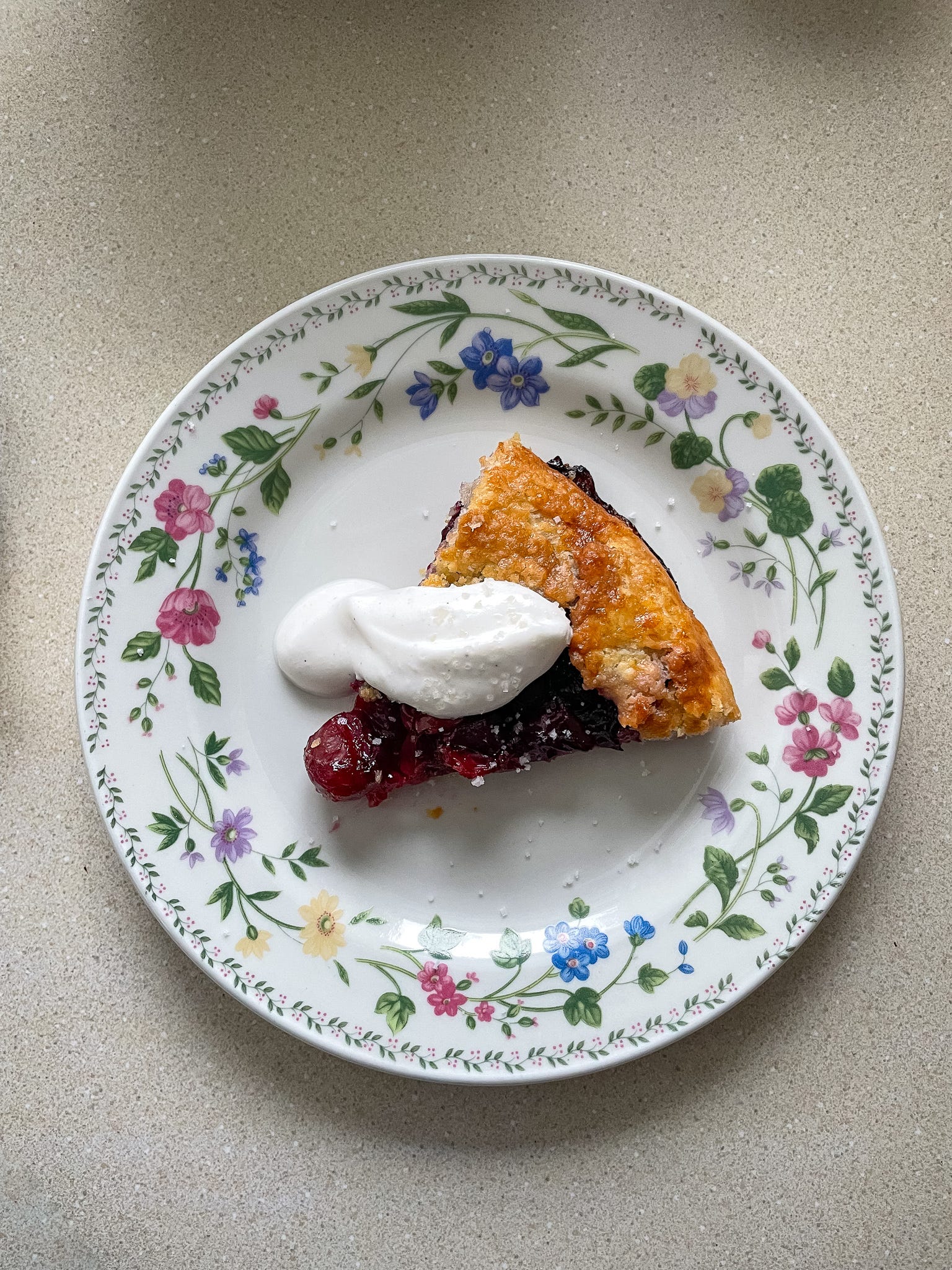
One of my favorite desserts to whip up is a rustic galette. The name says it all: rustic. When a dessert’s premise starts with rustic, it automatically takes the weight off your shoulders. There’s no room for precision here, for perfectly lined layers or a glossy finish.
A rustic dessert comes out however it wants to; you’re just there to sort of guide the process. I’ve actually tried polishing a galette once. Instead of just rolling out the dough and letting the edges fall where they may, I cut the character right out of them and gave them a symmetrical trim. The end result was perfectly sharp, geometric outlines.
But I realized I don’t want my desserts to be geometrical. I want them to be a little kooky — at least when it comes to my galettes.
Another reason I love these free-form, flat pastries is their versatility. A galette dough is the perfect canvas for whatever you want to fill it with: vegetables, fruit, savory, sweet, anything goes.
The dough is so easy, you don’t need more than thirty minutes to put it together. One thing I like to do is always keep one in the freezer. Just in case you need dessert and can’t think of anything, take the dough out to thaw, open your fridge, and see what can be turned into pie filling… and it’s that simple.



Blueberries are a popular galette filling, grapes are the outliers here. I happen to think grapes are far underappreciated, and maybe this is my attempt to do them justice. When baked, grapes caramelize and their sweetness intensifies. They collapse into a jammy consistency with a wine-adjacent taste. So why aren’t they present in more desserts?!
Since they’re about 80% water, they need to be cooked before going onto the dough so that some of that water is released. It’s imperative you use seedless grapes for this, as there’s nothing worse than biting into an accidental seed, let alone dozens of them. Any seedless red grape variety will work.
Together with the blueberries, they make a vibrant, sweet-and-tangy filling that’s full of antioxidants, and they complement each other very nicely.
Sitting atop a rich, flaky, buttery pastry and served with a dollop of softly whipped heavy cream, this is a dessert that’s all about simplicity.



This is a typical all-butter flaky dough, enriched with a little bit of heavy cream. When making galette dough, keep two things in mind: all ingredients must remain cold, and you must work quickly so as not to overwork it.
This sounds scarier than it actually is. Most people use a food processor when making dough, but I prefer to use my hands. I think working quickly with a fork and your fingertips is the best way to assess it (how wet or dry it is, etc.).
People often advise against over-hydrating galette dough, since water keeps it from being flaky — typically, you want your galette dough to be on the drier side. But don’t worry if it doesn’t look shaggy, it will most likely be okay.
My advice is to add water a little bit at a time, mixing as you go. It will come together in big clumps, so transfer those to a working surface and repeat the process with the remaining mixture in the bowl until you’re done.
You want to add just enough water to keep it together, so your dough will look rather dry at this stage. As it chills in the fridge it hydrates, and as you roll it out, it starts to come together more cohesively. What I’m trying to say is that, whether slightly under- or over-hydrated, it will be fine.

Ingredients
Dough:
155g (1¼ cups) all-purpose flour, plus more for surface
1 tbsp sugar, plus more for finishing (or use Turbinado sugar if you have it)
1 tsp kosher salt
142g (¾ cup) unsalted butter, cold
25g (1½ tbsp) heavy cream, cold
45g (3 tbsp) ice water, plus more as needed
1 egg, beaten, for egg wash
Filling:
400g (2½ cups) seedless red grapes
130g (1 cup) blueberries
¼ cup granulated sugar
¼ cup cornstarch
zest of 1 lemon
pinch of salt
Directions
Dough
Whisk flour, sugar, and salt in a medium bowl to combine.
Cut half the butter into cubes and thinly slice the remaining half. Add to the bowl and toss to coat the butter. Using your fingers, quickly smash the cubes and slices into smaller, flat, pea-sized pieces.
Drizzle in the heavy cream, mixing with a fork. Add the ice-cold water, one tablespoon at a time, mixing until the dough just starts to hold together in large clumps.
Transfer the clumps to a piece of plastic wrap, leaving the dry bits in the bowl. Drizzle more ice-cold water into the dry bits, just until they hold together when squeezed in your hand. Add this to the dough on the plastic wrap.
Wrap tightly into a square, pushing the dough into the into corners and pressing out any air pockets. Chill for 2 hours or overnight.
Filling
Add the grapes to a medium saucepan over medium-high heat. Press them down with the back of the spoon so they burst, and cook until they have broken down into juice, about 10 minutes. Transfer to a bowl and allow to cool completely.
Preheat the oven to 425°F/ (220°C). Line a baking sheet with parchment paper.
If the grapes have released too much juice, discard some of it. Whisk in the sugar, cornstarch, lemon zest, and salt to combine
Let the dough sit at room temperature for about 4 minutes to soften. On a lightly floured surface, roll it out into a ¼-inch-thick circle. Transfer the dough to the prepared baking sheet.
Spoon the filling into an even layer in the center of the circle, leaving 2 inches of uncovered dough all around. Fold the edges over the filling, pleating as needed to encase it, applying enough pressure to seal.
Brush the dough with the egg wash and sprinkle with sugar or turbinado sugar. Bake for 25-35 minutes, until the crust and bottom are golden brown. Serve.
See you next time, xo.